Medical Aesthetics News
Dear Doctors and Suppliers
We are looking for weekly feature contributions. If you would like to contribute please contact karen@probeauty.co.za. For more information on topics and deadlines click here. If you are a supplier and have a had a launch or have some exciting news that is industry related, we would like to mention it in our news section.
Need to look good fuels aesthetic treatment
14 April 2015
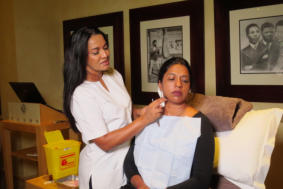
Dr Anushka Reddy prepping for the 4D thread procedure
Face-to-face social media is encouraging people to take pictures of themselves, leading to over self-evaluation of appearance. This is
driving the desire to look good and in turn impacting the aesthetics industry.
So said Dr Anushka Reddy of the Medi-Sculpt group of treatment centres at a presentation on the latest non-surgical aesthetic trends
held on 31 March at The Saxon in Sandton.
“Today there is so much pressure for people to look good. Since 2014 in America alone, aesthetic treatments have gone up by 12%. This
includes treatments such as botulin toxin, peeling, fillers and laser. I have seen an increase in patients at my aesthetic clinics over the last
six to 12 months.
“So, why are so many people worldwide undergoing aesthetic treatments? The answer is because so much more can be achieved within a
short space of time. The current trend is ‘less is more’ so that patients don’t end up with an unnatural, taught-looking face. Going to your
aesthetic doctor for botulin toxin has become as normal as going to the hair salon,” said Reddy, who is president of the South African
Association of Cosmetic Doctors (SAACD).
She noted that 2015 has seen the combining of different modalities and approaches in aesthetic treatments.
“The thread is the go-to-trend at the moment for achieving a similar effect to surgery. We also now have what’s known as the collagen
induction thread – a thread that stimulates production of the body’s own collagen once it is reabsorbed in the skin. Thread procedures
are for women in their 40s and 50s,” said Reddy.
There is also an increased demand for professional grade skincare treatments. Reddy continued: “However, people want results. Botulin
toxin and fillers are quick fixes. Cosmetic surgery and aesthetic treatments are no longer taboo. The demand for treatments, both surgical
and non-surgical, is growing.”
Reddy talked about the challenges of having a non-regulatory environment in South Africa. “There are medical device import loopholes
and there is minimal control from the authoritative bodies. So this means any doctor can legally inject a toxin or filler, perform a chemical
peel or do a laser treatment without training.
“Many products on the market are available without clinical data or safety and efficacy studies. We’ve seen some horrendous cases of
patients where aesthetic treatments have gone wrong – such as scarring, burnt tissue, necrosis, permanent facial distortion and
blindness.
“People need to go to doctors who understand the anatomy of the face and have lots of experience. Botulin toxin is a regulated Schedule
4 drug but some doctors grey import unregulated toxins.”
She made the point about how media plays a big role in sensationalising cosmetic surgery and non-invasive aesthetic treatments,
drawing on the examples of Hollywood actresses Renee Zellwegger and Uma Thurman, whose most recent pictures showed a marked
change in facial appearance.
“This type of negative publicity is bad for the industry,” commented Reddy. “So I would like the media to be positive and provide
qualified reports of treatments and print the potential risks. They should educate the public to be aware of unregistered products and
unqualified doctors. Without responsible media reports we are likely to see more botched procedures. The stronger economy means that
we can expect more treatments. A large percentage of clients is likely to be the ‘selfie generation’ who are young and have no disposable
income so may seek out cheap and potentially dangerous treatments.”
In concluding her presentation, Reddy noted that the average age of her patients has changed over the last 10 years – from 35 to 25.
Reddy then demonstrated a 4D thread lift, which is positioned as having a natural lifting effect and a gradual volumising effect as the
threads used contain polylactic acid and polydioxanone (PDO), which diffuse into the tissues once the threads are reabsorbed.